

THE CHARACTER OF THE Royal Collection of Faberge
was almost entirely shaped by the close relationships between the Russian, Danish and English royal
families, all of whom exchanged gifts when they gathered
for family occasions, anniversaries such as birthdays, and at
Easter and Christmas. A large proportion of the collection was
formed in this manner, mainly during the reign of King Edward
VII, whose consort Queen Alexandra had been introduced to
Faberge’s work by her sister Marie Feodorovna, wife of Tsar
Alexander III of Russia. Once Faberge’s London branch
had opened in 1903, the King and Queen and two of their
children, Princess Victoria and George, Prince of Wales,
purchased many pieces, as gifts for each other or for their
friends. The clientele of the London branch included friends
of the King and Queen who, well aware of the royal
couple’s admiration for Faberge’s wares, bought them many
gifts to add to their collection. Later Queen Mary, consort
of King George V, acquired many pieces by gift, her enthusiasm for Faberge also being well known. Further she made
her own purchases, particularly in the late 1920s and 1930s
when pieces of imperial provenance began to appear for
sale in the West. Many of these were given to King George
V Through the 1940s, 1950s and 1960s King George VI
and then Queen Elizabeth acquired a range of pieces which
were among the last to enter the collection.
Queen Alexandra (1844-1925) was undoubtedly the
most significant influence in the history of the formation of
the royal collection of Faberge. It is not known when her
sister, Tsarina Marie Feodorovna, first introduced her to
Faberge’s work. It may have been as early as 1881 when, as
Princess of Wales, she attended the funeral ceremonies of the
assassinated Tsar Alexander II in Moscow and St Petersburg with her husband, later King Edward VII. The Princess
of Wales stayed on after the funeral with her sister, whose
apartments certainly contained works by Faberge and other
court suppliers. It should be borne in mind that Gustav Faberge
(Carl’s father) had begun supplying the imperial court from
1866. At annual family holidays in Denmark, when the Prince
and Princess and Tsar and Tsarina would spend time together
with the King and Queen of Denmark, gifts were always
exchanged. Documents in the Russian State Historical Archives
reveal examples of Marie Feodorovna’s expenditure with
Faberge prior to her trips to Copenhagen.1
These are evidence
of the considerable number of pieces she took with her on such
occasions, some of which were no doubt given to her sister.
Queen Alexandra’s visits to Russia were in fact rare.
After the funeral of Alexander II she returned, as Princess
of Wales, for the wedding of Grand Duchess Xenia (1875-
1960) in August 1894, and in November of that year she
attended the funeral of her brother-in-law Tsar Alexander III
with the Prince of Wales and with George, Duke of York (later
King George V). The funeral was swiftly followed by the
marriage of Alexander Ill’s heir Tsar Nicholas II to Princess
Alix of Hesse. There is no personal account by Queen Alexandra of this prolonged visit but those of Prince George and
Charlotte Knollys (her Woman of the Bedchamber) survive.2
Prince George describes a visit to Faberge’s shop with his
father on Tuesday 20 November3
and Charlotte Knollys
one with the Princess of Wales on 22 November.4
The visit to
Russia coincided with the Princess’s birthday and the Duke
of York reports in his diary, on seeing his mother’s presents
set up as a birthday table at the Anichkov Palace, ‘motherdear’s
birthday . . . saw all the presents, she has got half Faberge’s
shop’.5
It is therefore clear that Queen Alexandra was acquiring many pieces of Faberge as presents from her family
from at least the 1880s. She also began to purchase pieces
before the London branch was opened for business. Her
accounts reveal two payments from her presents account to
‘C. Faberge’ for jewellery in May and December 1902.6
She
was, however, not the first member of the royal family to purchase works from Faberge. Queen Victoria’s accounts list two
payments to ‘C. Faberge’ for presents purchased in 1897
for ‘brooches etc.’ and in July 1898 for jewellery.7
Queen Victoria is not known for her interest in Faberge’s work but
she owned several pieces, including a red and oyster guilloche
enamel visitor’s book given to her by Tsar Nicholas II and Tsarina Alexandra Feodorovna in 1896, signed by those who
attended her Diamond Jubilee the following year (cat. 331).
Queen Alexandra and King Edward VII were the
raison d’etre for the opening of Faberge’s London branch in
1903. By this date they already owned a large number of pieces
by Faberge. Their collection was to grow considerably in
the following decade. The London branch was initially established by Arthur Bowe, one of three brothers involved in
Faberge’s business in Russia. Allan Bowe managed the Moscow
branch and sent his brother to set up an office in Berners Hotel
with stock from Moscow. The office moved briefly to Portman House, Duke Street, before the business arrangement
between Bowe and Faberge was ended. In 1906 Carl Faberge
established a branch of his St Petersburg business at 48 Dover
Street under the joint management of H.C. Bainbridge and
Nicholas Faberge, his youngest son. In 1911 this branch moved
to 173 New Bond Street where it remained until its closure
in 1915.
Queen Alexandra made regular visits to the branch,
usually timed to coincide with the arrival of new stock from
the workshops in Russia, which she often insisted on viewing before anyone else.8
Carl Faberge’s own awareness of the
particular tastes of the King and Queen combined with Bainbridge’s role as a go-between for the craftsman and his British
royal patrons meant that the branch was always stocked
with pieces that appealed to them. Bainbridge records how
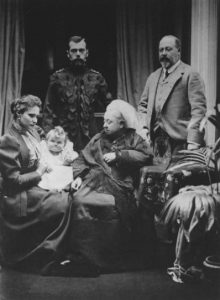
with Tsar Nicholas II, Tsarina Alexandra Feodorovna and their eldest
daughter, Grand Duchess Olga, at Balmoral, 1896. Photograph by
Robert Milne.
he would ‘ransack the Petersburg stock’ once a year. Carl
Faberge would then examine his selection and comment
‘the King and Queen won’t like any of them,’ and Bainbridge
would return to the drawing board.9
Clearly, not only were
both men eager to please their best customers, but Faberge
had a shrewd understanding of the objects which would be
most attractive to them.
Queen Alexandra’s taste was always for the more
modest of Faberge’s products. Her adoration of his animals
and flowers mirrored her preference for the simpler things
in life. She loved animals and was almost as devoted to her
dogs and horses as she was to her children. She was happiest at Sandringham House in Norfolk, where she was surrounded
by a menagerie of animals and where a cheerful and informal
spirit was the hallmark of her style of entertaining. She enjoyed
life at Marlborough House during the London season, but
it was at Sandringham that she kept her treasured collection of works by Faberge – in two cabinets in the Drawing
Room that were lit up with electric light each evening. Thus
the collection became known from this time as the Sandringham
Collection. Queen Alexandra was the recipient of many
gifts of Faberge animals and flowers, not only from the King but from her many friends. Bainbridge describes how objects
within a strict price bracket, not exceeding £50, were her preference, although occasionally this limit was exceeded. An
example is the chrysanthemum (cat. 140) purchased by Stanislas Poklewski-Koziell from the London branch in 1908 for
£117 and presented to Queen Alexandra; another is the crow
(cat. 32) purchased by the Queen herself in 1914 for £75.