

The Unbreakable Legacy: Nephrite Jade Armbands – Toughest Stone Ornaments
For millennia, civilizations have sought materials that defy time, substances that transcend mere beauty to embody endurance. Among the panoply of natural gems, one stands preeminent in its sheer tenacity: Nephrite Jade. Revered from the ancient Chinese dynasties to the Māori tribes of Aotearoa, its reputation as an indomitable stone is not folklore but a testament to its unique microcrystalline structure. While many gemstones dazzle with brilliance or exotic color, Nephrite Jade captivates with an almost mystical resistance to fracture, especially evident in its meticulously crafted armbands, known for their seemingly unbreakable interlocking fibers.
This article delves into the gemological marvel that makes Nephrite Jade armbands not just ornaments, but heirlooms built to last through generations, exploring the deep technical nuances and trade secrets behind their legendary durability and the artistry required to transform such a formidable material into objects of profound beauty and cultural significance.
The Gemological Marvel: Understanding Nephrite’s Structure and Unrivaled Toughness
To truly appreciate the “unbreakable” nature of a Nephrite Jade armband, one must first grasp its fundamental gemological properties. Nephrite is not a single mineral but a variety of the mineral actinolite, belonging to the amphibole group. Chemically, it’s a calcium-magnesium-iron silicate, distinct from Jadeite, the other mineral commonly referred to as jade. While Jadeite (a pyroxene) might boast a slightly higher Mohs hardness (6.5-7 vs. Nephrite’s 6-6.5), it is toughness—resistance to breaking, chipping, or fracturing under stress—where Nephrite reigns supreme.
The secret lies in its unique internal architecture: a dense, felted mass of interlocking, microscopic mineral fibers. Imagine countless needle-like crystals, randomly oriented and tightly interwoven, akin to a natural, high-performance composite material. When an external force is applied, instead of a clean cleavage plane propagating through a crystal lattice (as in diamonds or emeralds), the energy is dissipated across this intricate fibrous network. Each fiber must be individually broken or pulled apart, demanding immense energy. This is a trade secret known to ancient carvers and modern gemologists alike: while harder stones can be scratched, Nephrite’s ability to absorb shock without fracturing is unparalleled among natural materials.
This unparalleled toughness allows Nephrite to be carved into thin, intricate forms like armbands and bracelets, which would be dangerously fragile if made from most other gemstones. Its specific gravity typically ranges from 2.90 to 3.03, and its refractive index from 1.606 to 1.632, contributing to its characteristic soft, waxy to vitreous luster when polished. The most prized colors range from deep spinach green to creamy ‘mutton fat’ white, often with subtle translucency that hints at its internal fibrous glow.
Crafting Immortality: The Art of Nephrite Armband Creation
Fashioning an armband from a rough nephrite boulder is a testament to extraordinary skill, patience, and a profound understanding of the stone’s singular properties. Unlike carving brittle stones, where precise cuts and facets define the final form, working with nephrite is a process of laborious grinding and abrasion. Ancient cultures, lacking modern power tools, relied on persistent manual labor, utilizing harder abrasive sands (like quartz or later, corundum and garnet) combined with water to slowly erode and shape the stone.
For an armband, the process typically begins with slicing a disc from a large boulder. Then, both the outer circumference and, crucially, the inner core must be precisely removed. This hollowing-out process is particularly challenging. Historically, this involved ‘drilling’ from both sides with a rotating hollow reed or bamboo stick and abrasive slurry, gradually creating a core that could then be broken out. Modern methods employ diamond-impregnated tools and ultrasonic drills, but the fundamental principle of slow abrasion remains. Any attempt to rush or apply excessive localized force risks generating internal stress fractures that, though not immediately visible, could compromise the armband’s integrity down the line – a critical trade secret in maintaining Nephrite’s legendary toughness.
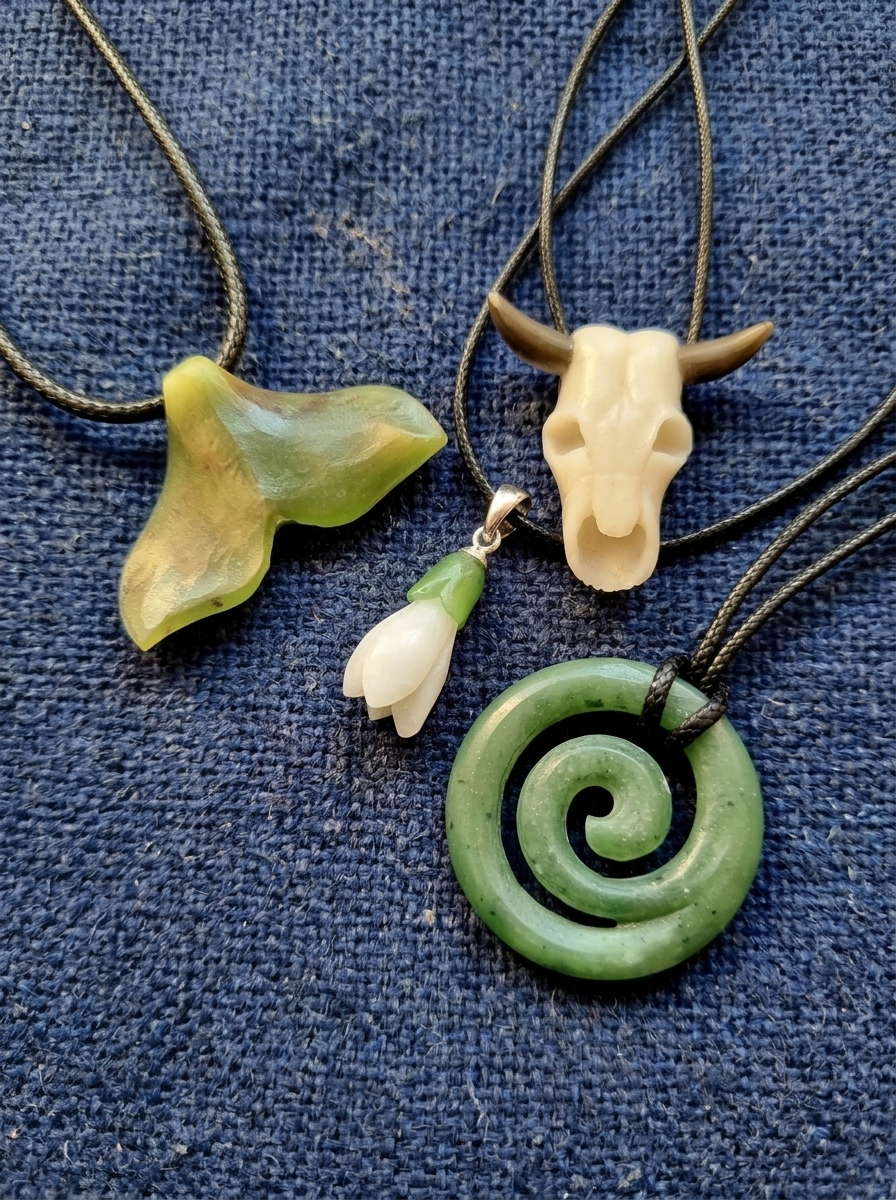
The final stages involve meticulous smoothing, polishing, and shaping to achieve the desired aesthetic and ergonomic fit. A high-quality nephrite armband will exhibit an exceptional polish, often enhancing its natural waxy luster and depth of color without showing any surface imperfections or tool marks. The precision required to maintain consistent thickness and a perfectly circular form, especially when dealing with such a dense and tough material, elevates these pieces beyond mere jewelry to true works of art. You can observe the intricate beauty and craftsmanship of such pieces by exploring collections like those found at stone-flower.com, where the tradition of skilled carving is celebrated.
Beyond Adornment: The Enduring Legacy and Value
Nephrite Jade armbands are more than just aesthetically pleasing; they carry a profound cultural and historical weight. In various societies, jade symbolized protection, longevity, wealth, and status. The Māori pounamu (nephrite jade) armbands and ornaments, for instance, are considered taonga – treasured possessions imbued with spiritual significance and passed down through generations. The very ‘unbreakability’ of the stone reinforced its symbolic meaning as something enduring, sacred, and eternal.
For collectors and enthusiasts today, the value of a Nephrite Jade armband is multifaceted. It’s not only about the raw material but also the artistry, historical provenance, and the stone’s intrinsic quality. Key indicators of value include:
- Color Uniformity & Saturation: Deep, consistent greens (spinach jade) or pure, creamy whites (mutton fat jade) without distracting mottling.
- Translucency: A desirable characteristic that allows light to penetrate and reveal the stone’s inner glow.
- Craftsmanship: The precision of the carving, the smoothness of the polish, and the absence of flaws or tool marks.
- Origin: Historically significant sources like Khotan (China), British Columbia (Canada), or the South Island (New Zealand) can add value.
Unlike many other gemstones that require delicate handling, Nephrite’s incredible toughness means these armbands are exceptionally durable and resilient for everyday wear. They are resistant to scratches from household dust (which often contains quartz) and impervious to most common chemicals. Simple cleaning with mild soap and water is typically all that’s needed to maintain their luster.
Investing in a high-quality Nephrite Jade armband is not merely acquiring a piece of jewelry; it is embracing a fragment of Earth’s most resilient beauty, a tangible connection to ancient traditions, and a personal testament to enduring strength. When considering such an acquisition, especially for authentic hand-carved pieces, reliable sources are paramount. For exquisite examples of this timeless artistry, one might explore the curated collections at stone-flower.com, a renowned specialist in natural stone carvings, where the legacy of Nephrite continues to thrive.
FAQs about Nephrite Jade Armbands
Q1: What makes Nephrite Jade armbands tougher than other gemstone jewelry?
A1: Nephrite Jade’s unparalleled toughness stems from its unique internal structure: a dense, felted aggregate of microscopic, interlocking mineral fibers. This allows it to absorb and dissipate impact energy much more effectively than other gemstones, which typically have crystalline structures prone to cleavage or fracture.
Q2: How can I tell if a Nephrite Jade armband is authentic?
A2: Authenticity is determined by gemological testing. Look for characteristic properties like a specific gravity between 2.90-3.03, a refractive index of 1.606-1.632, and a distinctive waxy to vitreous luster. Visual inspection for consistency of color, translucency, and the absence of dye (which can often be detected in crevices) is also helpful, but professional gemological assessment is the most reliable method.
Q3: Are Nephrite Jade armbands susceptible to damage or scratches?
A3: While incredibly tough and resistant to breaking, Nephrite Jade can still be scratched by materials harder than itself (Mohs 6-6.5), such as quartz (Mohs 7), corundum (Mohs 9), or diamonds (Mohs 10). It’s advisable to store jade jewelry separately to prevent rubbing against harder stones, though its overall resilience makes it an excellent choice for daily wear.