

Onyx: The Parallel-Banded Chalcedony Often Mistaken for Natural Black Stone
Most black onyx sold today is not naturally black. The glossy dark gemstone widely used in jewelry is usually a dyed form of chalcedony—a microcrystalline quartz altered through controlled chemical treatment. Yet genuine onyx remains one of the most geologically fascinating silica materials, defined by its parallel banding and highly ordered microstructure.
Understanding onyx requires looking beyond jewelry marketing and into mineralogy, lapidary science, and gemstone treatment technology.
What Is Onyx? Mineralogical Definition
True onyx is a parallel-banded variety of chalcedony, itself a cryptocrystalline form of quartz composed primarily of silicon dioxide (SiO₂).
- Chemical composition: SiO₂
- Mineral group: Chalcedony (Quartz family)
- Crystal system: Trigonal (microcrystalline aggregate)
- Hardness: 6.5–7 (Mohs scale)
- Luster: Waxy to vitreous
The defining characteristic of true onyx is its straight, parallel color banding, which distinguishes it from agate, where bands are typically curved or irregular.
How Onyx Forms in Nature
Onyx forms through low-temperature silica deposition within cavities, fractures, and hydrothermal environments.
Silica-rich fluids precipitate microscopic quartz fibers layer by layer, gradually producing banded structures.
Formation environments include:
- Volcanic cavities and vesicles
- Hydrothermal veins
- Sedimentary silica replacement zones
Geological insight: The parallel banding develops from rhythmic fluctuations in fluid chemistry, oxidation conditions, and trace element concentration during silica precipitation.
Even microscopic changes in iron or manganese content can produce sharply contrasting layers.
Why Most “Black Onyx” Is Dyed
Natural black onyx exists but is relatively uncommon in commercial quantities. Most black onyx available today begins as gray, white, or lightly banded chalcedony that undergoes artificial darkening.
Traditional dyeing process:
- Stone is soaked in sugar solution
- Acid treatment carbonizes absorbed sugars
- Carbon particles create deep black coloration
Trade secret from gemstone treatment labs: The dye penetrates micro-porous zones unevenly, which is why magnification sometimes reveals concentrated darkening along fractures and band boundaries.
Modern treatments may also use polymer stabilization or synthetic dyes for enhanced color consistency.
Microstructure: Why Onyx Is Tougher Than It Looks
Although chalcedony lacks large visible crystals, its microscopic structure is highly complex.
Onyx consists of intergrown:
- Quartz fibers
- Moganite phases
- Microcrystalline silica aggregates
This fibrous interlocking texture gives onyx relatively good toughness despite its brittle quartz chemistry.
Materials science insight: The dense cryptocrystalline structure distributes stress more evenly than macrocrystalline quartz, reducing cleavage-related fracture risk.
Natural Onyx vs Dyed Chalcedony
Professional gemologists separate natural and treated material using advanced inspection techniques.
Indicators of dyed onyx:
- Concentrated color along fractures
- Uneven saturation under magnification
- Residual gray or white zones near edges
Indicators of natural onyx:
- Consistent mineral-based coloration
- Natural parallel banding
- No dye accumulation in porous zones
Expert gemological tip: Fiber-optic illumination often reveals hidden banding beneath dark dye treatments, exposing the underlying chalcedony structure.
Cutting and Polishing Onyx
Onyx responds exceptionally well to polishing due to its ultra-fine silica grain structure.
Professional lapidaries use:
- Diamond wheels for shaping
- Cerium oxide for final polish
- Low vibration settings to avoid edge chipping
Lapidary trade secret: The best polish appears when the final buffing stage slightly warms the surface, allowing microscopic silica fibers to align more uniformly and reflect light evenly.
Historical and Decorative Importance
Onyx has been used since antiquity for:
- Cameo carving
- Seal stones
- Architectural inlays
- Victorian mourning jewelry
The sharp contrast between black and white bands made it ideal for relief carving, where layered colors could produce dramatic visual depth.
Onyx in Modern Jewelry
Today, black onyx remains popular in rings, pendants, cufflinks, and beads due to:
- Strong contrast aesthetics
- Excellent polish retention
- Affordable availability
However, treated material dominates the market, and transparency regarding enhancement is essential for ethical gemstone trade.
Onyx vs Other Black Gemstones
- Obsidian: volcanic glass with conchoidal fracture
- Jet: fossilized organic material
- Black spinel: crystalline oxide mineral
- Tourmaline: borosilicate crystal structure
Onyx is unique due to its microfibrous silica structure and banded growth pattern.
Durability and Wearability
Onyx offers moderate durability suitable for jewelry, but it still requires proper handling.
- Avoid ultrasonic cleaners
- Protect from hard impacts
- Store separately from harder gemstones
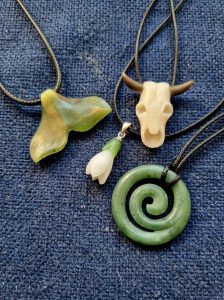
For materials requiring even greater toughness, nephrite jade remains one of the strongest natural ornamental stones.
Nephrite jade pendants are available for purchase on our website, stone-flower.com, offering handcrafted pieces with exceptional structural durability and natural beauty.
Geological Significance of Chalcedony Systems
Onyx and related chalcedony varieties preserve important geological information about fluid evolution and silica transport.
Scientists study chalcedony banding to reconstruct:
- Hydrothermal fluid chemistry
- Temperature fluctuations
- Oxidation-reduction cycles
Each band effectively records a separate stage of mineral deposition.
FAQ
Is black onyx naturally black?
Sometimes, but most black onyx sold commercially is dyed chalcedony treated to achieve deep black coloration.
What makes onyx different from agate?
Onyx has straight, parallel bands, while agate usually displays curved or irregular banding patterns.
Is onyx durable enough for daily jewelry?
Yes, onyx is durable enough for many jewelry applications, though it should still be protected from strong impacts and abrasives.