

Orthoclase: The Potassium Feldspar That Defines Hardness Level 6
Every geology student learns one critical benchmark on the Mohs hardness scale: orthoclase defines level 6. This potassium-rich feldspar is more than a classroom reference mineral—it is one of the most important rock-forming components in Earth’s continental crust and a key ingredient in granite formation.
Orthoclase controls the texture of igneous rocks, influences industrial ceramic production, and provides mineralogists with essential clues about magma cooling history.
What Is Orthoclase? Chemical and Structural Identity
Orthoclase is a potassium aluminum tectosilicate belonging to the feldspar group, the most abundant mineral family in Earth’s crust.
- Chemical formula: KAlSi₃O₈
- Mineral group: Feldspar
- Crystal system: Monoclinic
- Hardness: 6 on the Mohs scale
- Cleavage: Two perfect cleavages at nearly 90°
The name “orthoclase” derives from the Greek words for “straight fracture,” referencing its nearly perpendicular cleavage planes.
Why Orthoclase Defines Mohs Hardness Level 6
The Mohs hardness scale is based on relative scratch resistance, and orthoclase occupies a critical midpoint between softer minerals like apatite and harder minerals like quartz.
- Talc = 1
- Gypsum = 2
- Calcite = 3
- Fluorite = 4
- Apatite = 5
- Orthoclase = 6
- Quartz = 7
Professional gemological insight: Orthoclase is hard enough to scratch glass but still vulnerable to abrasion from quartz dust, which explains why feldspar-rich rocks weather faster than quartz-rich materials.
Orthoclase in Granite: The Foundation of Continental Crust
Orthoclase is one of the defining minerals of granite, often appearing as pink, cream, or white crystals intergrown with quartz and mica.
Granitic magmas crystallize slowly beneath Earth’s surface, allowing orthoclase crystals to grow large enough to become visually distinct.
Common granite mineral assemblage:
- Orthoclase feldspar
- Quartz
- Biotite mica
- Muscovite mica
- Plagioclase feldspar
Igneous petrology insight: The ratio between potassium feldspar and plagioclase is used to classify granite varieties and determine magma evolution pathways.
Atomic Structure and Cleavage Mechanics
Orthoclase belongs to the tectosilicate framework minerals, where silicon-oxygen tetrahedra form a three-dimensional network.
Potassium ions occupy structural cavities within this framework, stabilizing the crystal lattice.
Technical insight: Orthoclase cleavage occurs along planes where ionic bonding density is weakest, creating the characteristic near-90° fracture geometry used in mineral identification.
This cleavage pattern is a key field diagnostic separating feldspars from quartz, which lacks cleavage entirely.
Formation Conditions and Geological Environments
Orthoclase forms primarily in:
- Granitic intrusive rocks
- Pegmatites
- High-grade metamorphic rocks
- Hydrothermal veins
Slow cooling environments favor larger crystal growth and improved crystal ordering.
Trade secret from petrology labs: The degree of aluminum-silicon ordering within orthoclase can reveal cooling rates of the host magma, making feldspar an important geological thermometer.
Orthoclase vs Microcline and Sanidine
Orthoclase belongs to the potassium feldspar series, which includes structurally related minerals:
- Sanidine: high-temperature form
- Orthoclase: intermediate-temperature form
- Microcline: low-temperature ordered form
All share the same chemical composition but differ in atomic ordering and crystal symmetry.
Advanced mineralogical insight: Under polarized light microscopy, microcline displays characteristic tartan twinning absent in orthoclase, allowing precise petrographic identification.
Industrial Importance of Orthoclase Feldspar
Orthoclase is essential in several manufacturing industries:
- Ceramics: flux material lowering melting temperature
- Glass production: source of potassium and alumina
- Fillers: paints and plastics
- Abrasives: mild polishing compounds
Industrial processing insight: Feldspar purity directly affects ceramic translucency and firing stability. Iron contamination can produce unwanted discoloration during kiln firing.
Weathering Behavior and Soil Formation
Orthoclase is chemically less stable than quartz at Earth’s surface. Through hydrolysis reactions, it gradually alters into clay minerals such as kaolinite.
Typical weathering reaction:
- Orthoclase + water + carbonic acid → kaolinite + dissolved silica + potassium ions
This process is fundamental in soil development and nutrient cycling.
Geochemical insight: Potassium released from feldspar weathering becomes an essential nutrient source for plant growth in many terrestrial ecosystems.
Gem Varieties and Decorative Use
Some orthoclase varieties are highly valued as gemstones:
- Moonstone: adularescence effect from feldspar lamellae
- Sunstone: aventurescence from reflective inclusions
These optical effects arise from microscopic structural features rather than pigmentation alone.
Material Durability and Carving Comparison
While orthoclase is moderately hard, its cleavage makes it vulnerable to breakage during carving and impact.
For durable ornamental carving, nephrite jade performs far better due to its interlocking fibrous crystal structure.
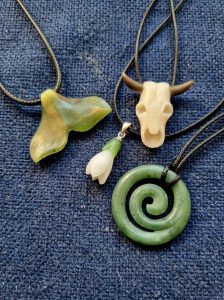
Nephrite jade pendants are available for purchase on our website, stone-flower.com, offering exceptional toughness and handcrafted natural artistry.
Identification Techniques Used by Professionals
Field geologists identify orthoclase using several diagnostic properties:
- Hardness of 6
- Two cleavages near 90°
- Pink or cream coloration in granite
- Vitreous luster
Professional field tip: Fresh orthoclase surfaces reflect light differently across cleavage planes, producing subtle directional sheen changes visible under sunlight.
FAQ
Why is orthoclase important on the Mohs scale?
Orthoclase defines hardness level 6, serving as the standard reference for minerals capable of scratching glass.
What role does orthoclase play in granite?
It is one of granite’s primary minerals and helps determine the rock’s composition, color, and crystallization history.
How is orthoclase different from quartz?
Orthoclase has cleavage planes and slightly lower hardness, while quartz lacks cleavage and is harder at Mohs level 7.