

Pectolite: The Volcanic Silicate Behind Rare Caribbean Larimar
One volcanic mineral created a gemstone so geographically restricted that it exists naturally in only one place on Earth. Pectolite, a calcium sodium silicate formed in volcanic environments, is usually gray or white. Yet under rare geological conditions involving copper-rich fluids, it transforms into Larimar—the striking blue gemstone found exclusively in the Caribbean.
This transformation is not cosmetic. It is the result of highly specific hydrothermal chemistry, crystal growth conditions, and volcanic alteration processes that occurred over millions of years.
What Is Pectolite? Mineralogical Structure and Composition
Pectolite is a hydrous sodium calcium silicate hydroxide belonging to the inosilicate mineral group.
- Chemical formula: NaCa₂Si₃O₈(OH)
- Mineral class: Inosilicates
- Crystal system: Triclinic
- Hardness: 4.5–5 on the Mohs scale
- Luster: Silky to vitreous
Pectolite forms radiating fibrous aggregates rather than large euhedral crystals. These fibrous structures strongly influence both durability and optical appearance.
Formation in Volcanic Rocks
Pectolite commonly develops through hydrothermal alteration within basaltic volcanic rocks. Mineral-rich fluids circulate through fractures and cavities left by cooling lava flows.
Typical formation environments include:
- Basalt vesicles
- Hydrothermal veins
- Altered volcanic tuffs
- Low-temperature metamorphic zones
Geological insight: Pectolite often crystallizes during late-stage hydrothermal activity when sodium- and calcium-rich fluids interact with silica-bearing volcanic host rocks.
The fibrous habit results from directional crystal growth in confined fluid pathways.
Larimar: The Rare Blue Variety of Pectolite
Larimar is the rare blue gemstone variety of pectolite, found only in the Dominican Republic, specifically within the Bahoruco region.
The blue coloration comes primarily from:
- Copper substitution within the crystal structure
- Scattering effects from fibrous crystal aggregates
- Variable oxidation states during mineral formation
Professional mineralogy insight: The intensity of Larimar’s blue depends not only on copper concentration but also on how uniformly fibrous microstructures scatter incoming light.
This creates the cloud-like, oceanic appearance for which Larimar is famous.
Why Larimar Exists Only in the Caribbean
The rarity of Larimar is geological, not marketing-driven. Its formation required a highly unusual combination of conditions:
- Basaltic volcanic activity
- Hydrothermal silica-rich fluids
- Copper-bearing geochemistry
- Specific low-temperature crystallization environment
Trade secret from economic geology: Similar volcanic systems exist worldwide, but the exact balance of copper mobility, pH conditions, and silica saturation needed for blue pectolite formation is exceptionally rare.
This is why commercial Larimar deposits remain exclusive to the Caribbean.
Crystal Structure and Optical Behavior
Pectolite’s triclinic crystal system creates elongated fibrous crystals that intergrow densely.
This produces:
- Silky visual texture
- Diffuse light scattering
- Soft chatoyant appearance in polished material
Gemological insight: High-quality Larimar displays internal color zoning caused by fluctuating copper concentration during crystal growth phases.
Unlike transparent gemstones, Larimar’s beauty comes from diffuse structural optics rather than clarity.
Lapidary Challenges and Cutting Techniques
Larimar and pectolite require careful handling during cutting due to their fibrous structure and moderate hardness.
Professional cutting considerations:
- Low-pressure grinding to avoid fiber separation
- Diamond abrasives preferred for stable shaping
- Controlled polishing temperatures to prevent dehydration
Lapidary trade secret: The best polish is achieved using cerium oxide at slow rotational speeds, which preserves the delicate fibrous reflection patterns without surface burning.
Improper polishing can flatten optical texture and reduce perceived color depth.
How Experts Identify Natural Larimar
Professional gemologists distinguish genuine Larimar from imitations using:
- Fibrous internal texture under magnification
- Variable cloud-like color zoning
- Characteristic Mohs hardness range
- Distinctive white matrix patterns
Expert authentication insight: Dyed imitation stones often display unnatural color concentration along fractures, whereas natural Larimar shows diffuse blue distribution integrated into the crystal aggregate.
Pectolite Compared to Other Blue Gemstones
- Turquoise: phosphate mineral with granular texture
- Aquamarine: transparent beryl crystal
- Blue calcite: softer carbonate mineral
- Larimar: fibrous volcanic silicate with cloud-like patterns
Larimar is unique because its appearance combines fibrous optics, hydrothermal coloration, and volcanic origin.
Durability and Jewelry Use
With hardness between 4.5 and 5, pectolite is softer than quartz-based gemstones and requires protective settings in jewelry.
It is best suited for:
- Pendants
- Earrings
- Occasional-wear rings
Heavy abrasion can damage polished surfaces over time.
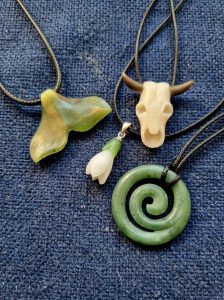
For significantly higher toughness, nephrite jade remains one of the strongest natural carving and jewelry materials due to its dense interlocking fibrous structure.
Nephrite jade pendants are available for purchase on our website, stone-flower.com, offering exceptional durability combined with handcrafted artistry.
Geological Importance of Hydrothermal Silicates
Pectolite provides valuable information about volcanic hydrothermal systems and fluid-rock interactions.
Geologists study pectolite-bearing environments to understand:
- Post-volcanic alteration processes
- Fluid chemistry evolution
- Trace metal transport mechanisms
Its occurrence often indicates low-temperature hydrothermal conditions associated with late-stage volcanic activity.
Care and Preservation
Proper care is essential for preserving Larimar jewelry and specimens:
- Avoid prolonged sunlight exposure
- Protect from acidic chemicals
- Store separately from harder gemstones
- Clean with mild soap and soft cloth only
Its fibrous structure can lose surface polish if exposed to abrasive environments.
FAQ
What makes Larimar blue?
The blue coloration comes primarily from copper-related chemical substitutions combined with light scattering through fibrous crystal structures.
Where is Larimar found naturally?
Natural Larimar is found only in the Dominican Republic within volcanic host rocks.
Is Larimar durable enough for daily jewelry?
It is suitable for pendants and earrings but requires care because its hardness is lower than quartz-based gemstones.