To order a pendant or a stone sculpture, write to us in Telegram!
The crafting of jade pendants has ancient roots both in China and among the indigenous peoples of New Zealand. In both regions, jade was highly valued, not only for its beauty but also for its spiritual significance.
In China, jade objects, including pendants, were made as early as the Neolithic period, around 6,000 years ago. Jade was seen as a symbol of purity, strength, and immortality. Chinese artisans used primitive tools to carve jade and then polished it to a smooth finish, creating amulets, ornaments, and figurines. Pendants held a special place, often symbolizing the forces of heaven and earth, and were worn as protective talismans. The Maori, the indigenous people of New Zealand, also crafted jade pendants, known as “pounamu.” For them, jade was the “stone of life,” passed down through generations and used in rituals. One of the most common shapes was the “hei-tiki” — a stylized human figure that represented ancestors and spiritual protection. Maori artisans used hand-polishing techniques and drilled holes for cords. Thus, in both cultures, jade pendants served not only as decorative items but also as powerful symbols of protection and deep spiritual meaning.Our Jade pendants
are made in limited quantities, ensuring that each piece remains exclusive. When you wear one of our pendants, you carry with you a rare and unique item that cannot be mass-produced. The meticulous handcrafting process guarantees that no two pieces are exactly alike, giving each pendant its own personality and charm. By choosing one of our Jade pendants, you invest in more than just a beautiful piece of jewelry. You acquire a symbol of elegance, strength, and individuality. Whether as a gift or a personal treasure, our Jade pendants will serve as a lasting reminder of the timeless beauty and craftsmanship of natural jade.To order a pendant or a stone sculpture, write to us in Telegram!
The crafting of jade pendants has ancient roots both in China and among the indigenous peoples of New Zealand. In both regions, jade was highly valued, not only for its beauty but also for its spiritual significance.
In China, jade objects, including pendants, were made as early as the Neolithic period, around 6,000 years ago. Jade was seen as a symbol of purity, strength, and immortality. Chinese artisans used primitive tools to carve jade and then polished it to a smooth finish, creating amulets, ornaments, and figurines. Pendants held a special place, often symbolizing the forces of heaven and earth, and were worn as protective talismans. The Maori, the indigenous people of New Zealand, also crafted jade pendants, known as “pounamu.” For them, jade was the “stone of life,” passed down through generations and used in rituals. One of the most common shapes was the “hei-tiki” — a stylized human figure that represented ancestors and spiritual protection. Maori artisans used hand-polishing techniques and drilled holes for cords. Thus, in both cultures, jade pendants served not only as decorative items but also as powerful symbols of protection and deep spiritual meaning.Explore a related jade piece from Stone-Flower:

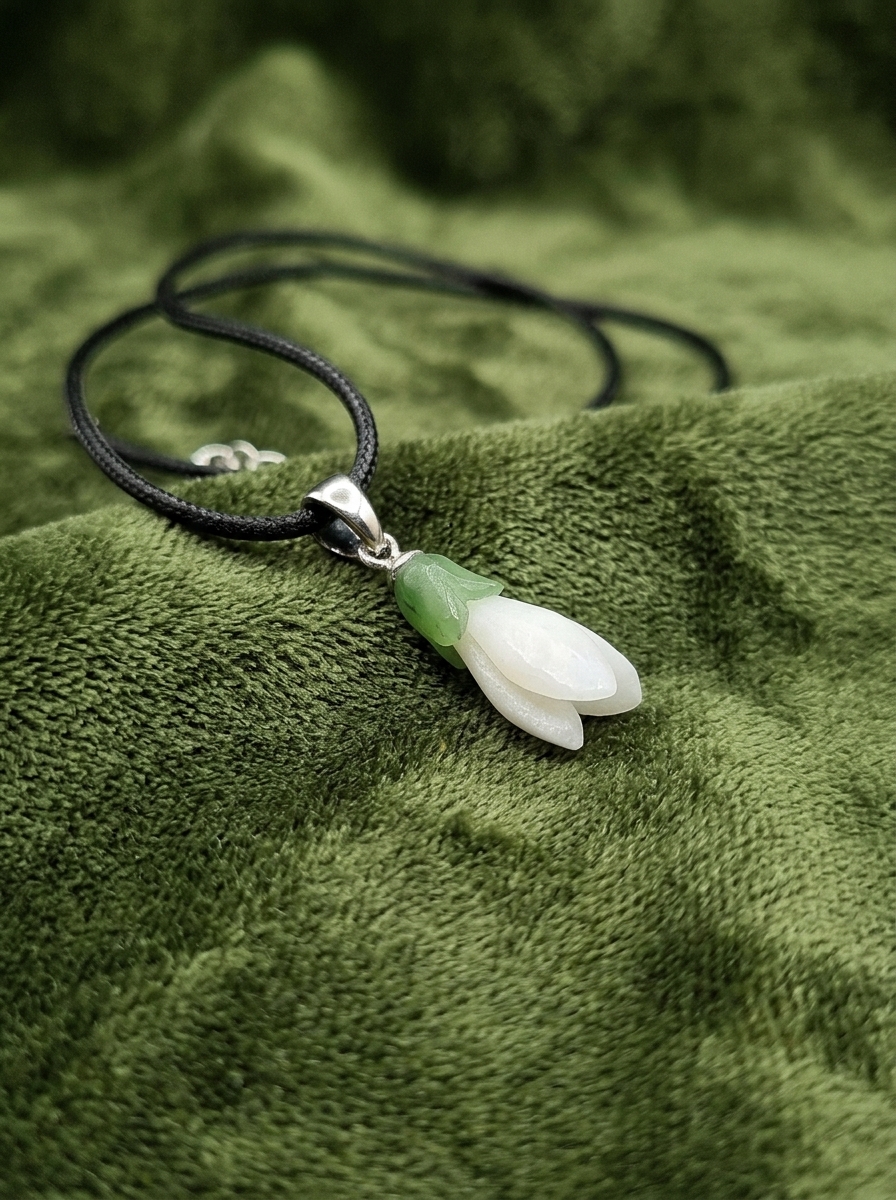
Snowdrop Jade Pendant — White & Green Siberian Nephrite, Hand-Carved, 2.5 cm
Hand-Carved Siberian Jade "Snowdrop" Pendant (2.5 cm)
A delicate botanical flower pendant measuring 2.5 cm in length, hand-carved from genuine Siberian jade. Features three sculpted petals of translucent white jade beneath a rich green jade sepal. Finished with meticulous hand polishing without waxes, varnishes, or chemical sealants, highlighting the pure natural luster of the stone. Fitted with a hypoallergenic medical-grade metal bail on a cord.
Our Jade pendants
are made in limited quantities, ensuring that each piece remains exclusive. When you wear one of our pendants, you carry with you a rare and unique item that cannot be mass-produced. The meticulous handcrafting process guarantees that no two pieces are exactly alike, giving each pendant its own personality and charm. By choosing one of our Jade pendants, you invest in more than just a beautiful piece of jewelry. You acquire a symbol of elegance, strength, and individuality. Whether as a gift or a personal treasure, our Jade pendants will serve as a lasting reminder of the timeless beauty and craftsmanship of natural jade.To order a pendant or a stone sculpture, write to us in Telegram!
The crafting of jade pendants has ancient roots both in China and among the indigenous peoples of New Zealand. In both regions, jade was highly valued, not only for its beauty but also for its spiritual significance.
In China, jade objects, including pendants, were made as early as the Neolithic period, around 6,000 years ago. Jade was seen as a symbol of purity, strength, and immortality. Chinese artisans used primitive tools to carve jade and then polished it to a smooth finish, creating amulets, ornaments, and figurines. Pendants held a special place, often symbolizing the forces of heaven and earth, and were worn as protective talismans. The Maori, the indigenous people of New Zealand, also crafted jade pendants, known as “pounamu.” For them, jade was the “stone of life,” passed down through generations and used in rituals. One of the most common shapes was the “hei-tiki” — a stylized human figure that represented ancestors and spiritual protection. Maori artisans used hand-polishing techniques and drilled holes for cords. Thus, in both cultures, jade pendants served not only as decorative items but also as powerful symbols of protection and deep spiritual meaning.Our Jade pendants
are made in limited quantities, ensuring that each piece remains exclusive. When you wear one of our pendants, you carry with you a rare and unique item that cannot be mass-produced. The meticulous handcrafting process guarantees that no two pieces are exactly alike, giving each pendant its own personality and charm. By choosing one of our Jade pendants, you invest in more than just a beautiful piece of jewelry. You acquire a symbol of elegance, strength, and individuality. Whether as a gift or a personal treasure, our Jade pendants will serve as a lasting reminder of the timeless beauty and craftsmanship of natural jade.To order a pendant or a stone sculpture, write to us in Telegram!
The crafting of jade pendants has ancient roots both in China and among the indigenous peoples of New Zealand. In both regions, jade was highly valued, not only for its beauty but also for its spiritual significance.
In China, jade objects, including pendants, were made as early as the Neolithic period, around 6,000 years ago. Jade was seen as a symbol of purity, strength, and immortality. Chinese artisans used primitive tools to carve jade and then polished it to a smooth finish, creating amulets, ornaments, and figurines. Pendants held a special place, often symbolizing the forces of heaven and earth, and were worn as protective talismans. The Maori, the indigenous people of New Zealand, also crafted jade pendants, known as “pounamu.” For them, jade was the “stone of life,” passed down through generations and used in rituals. One of the most common shapes was the “hei-tiki” — a stylized human figure that represented ancestors and spiritual protection. Maori artisans used hand-polishing techniques and drilled holes for cords. Thus, in both cultures, jade pendants served not only as decorative items but also as powerful symbols of protection and deep spiritual meaning.Explore a related jade piece from Stone-Flower:
Snowdrop Jade Pendant — White & Green Siberian Nephrite, Hand-Carved, 2.5 cm
Hand-Carved Siberian Jade "Snowdrop" Pendant (2.5 cm)
A delicate botanical flower pendant measuring 2.5 cm in length, hand-carved from genuine Siberian jade. Features three sculpted petals of translucent white jade beneath a rich green jade sepal. Finished with meticulous hand polishing without waxes, varnishes, or chemical sealants, highlighting the pure natural luster of the stone. Fitted with a hypoallergenic medical-grade metal bail on a cord.