Calcite Common Carbonate: Clear Iceland Spar Double Refraction
Clickable Title (under 60 chars):
Iceland Spar: Double Refraction in Clear Calcite
Introduction: When One Line Becomes Two
Place a transparent rhombus of Iceland spar over a single black line on white paper. Look through the crystal. You don’t see one line—you see two. Rotate the stone, and one image drifts around the other like an optical ghost. This isn’t a trick of light. It’s double refraction, and it’s the physical signature of calcite’s unusual crystal structure.
Most people have never seen true double refraction because common glass, quartz, and even diamonds don’t show it to the naked eye. But Iceland spar (optical-grade clear calcite) splits light so aggressively that the effect is unmistakable. Here’s the technical reason: calcite has a birefringence value of Δn = 0.172, one of the highest of any transparent mineral. For comparison, quartz’s birefringence is only 0.009—twenty times weaker.
In this guide, you’ll learn exactly how Iceland spar works, how to test it, how to identify genuine material, and why this common carbonate became a Viking navigation tool and a modern optical component. Что кулоны из нефрита можно купить на нашем сайте — but calcite is a different category entirely, prized not for carving but for its physics.
What Is Calcite? The Common Carbonate Explained
Calcite (CaCO₃) is the most stable polymorph of calcium carbonate. It makes up limestone, marble, chalk, travertine, and many cave formations. But most calcite is opaque or translucent at best. Iceland spar is the rare exception—large, clear, colorless crystals with perfect transparency.
Mineralogical identity:
Crystal system: Trigonal – hexagonal scalenohedral class (space group R3̅c)
Cleavage: Perfect rhombohedral in three directions (not 90° angles—instead 75° and 105°)
Hardness: 3 on Mohs scale (scratches easily with a copper coin)
Specific gravity: 2.71
Luster: Vitreous to pearly on cleavage surfaces
Diagnostic field test: Apply a drop of cold dilute hydrochloric acid (5–10% HCl) to any calcite surface. It fizzes violently as CO₂ gas is released. No other common clear mineral reacts this way.
The Physics of Double Refraction: Ordinary vs. Extraordinary Rays
Here’s what happens at the crystal level. Light enters Iceland spar and encounters an anisotropic structure—meaning atomic spacing differs depending on direction. The crystal splits the light into two polarized rays:
Ordinary ray (o-ray) – Behaves normally. Refractive index = 1.658. Obeys Snell’s law. Does not change speed with crystal orientation.
Extraordinary ray (e-ray) – Behaves anomalously. Refractive index varies between 1.486 and 1.658 depending on propagation direction. Does not obey standard Snell’s law.
Because the two rays travel at different speeds through the crystal, they exit at different points. When you look through the crystal, your eye receives two separate images of the same object, shifted relative to each other. The maximum separation angle in high-purity Iceland spar reaches approximately 25 degrees—large enough to see clearly with the naked eye.
Expert note: The extraordinary ray’s refractive index equals the ordinary ray’s along the crystal’s optic axis. That means if you align the crystal correctly, double refraction disappears entirely. Rotate 90 degrees, and it maximizes. This orientation sensitivity is proof you’re holding true calcite, not glass or plastic.
Viking Sunstones: Historical Navigation with Iceland Spar
Medieval Norse sagas describe “sólarsteinn” (sunstones) used to locate the sun on overcast days or after sunset. For centuries, scholars called this myth. Then in 2002, an Iceland spar crystal was recovered from the Alderney Elizabethan warship wreck (1592). Optical testing confirmed: by rotating the crystal until the double images exhibited equal brightness, a navigator could determine the sun’s true azimuth within 1 degree—even through heavy cloud cover or twilight.
How the technique works:
Hold Iceland spar steady and observe two image patches
Rotate the crystal slowly until both patches show equal intensity
The crystal’s orientation now points directly at the sun’s location behind clouds
Modern polarimetric measurements confirm 92% accuracy under overcast skies
This worked because calcite’s extraordinary ray is fully polarized perpendicular to the ordinary ray. Clouds scatter light but preserve polarization information. The human eye cannot detect polarization directly—but Iceland spar converts polarization into visible brightness differences.
How to Identify Genuine Iceland Spar
The market contains many fakes and mislabeled materials. Here are laboratory-grade identification methods:
Test #1 – The line test (field portable):
Place crystal flat on printed text or graph paper
Look straight down through the thickest dimension
Genuine Iceland spar shows two sharp, clearly separated lines
Rotate the crystal: the separation distance changes but remains crisp
Fake material (glass, quartz, acrylic) shows blur, not doubling
Test #2 – The acid test (destructive on small scale):
Scratch a tiny corner of the crystal with a steel needle
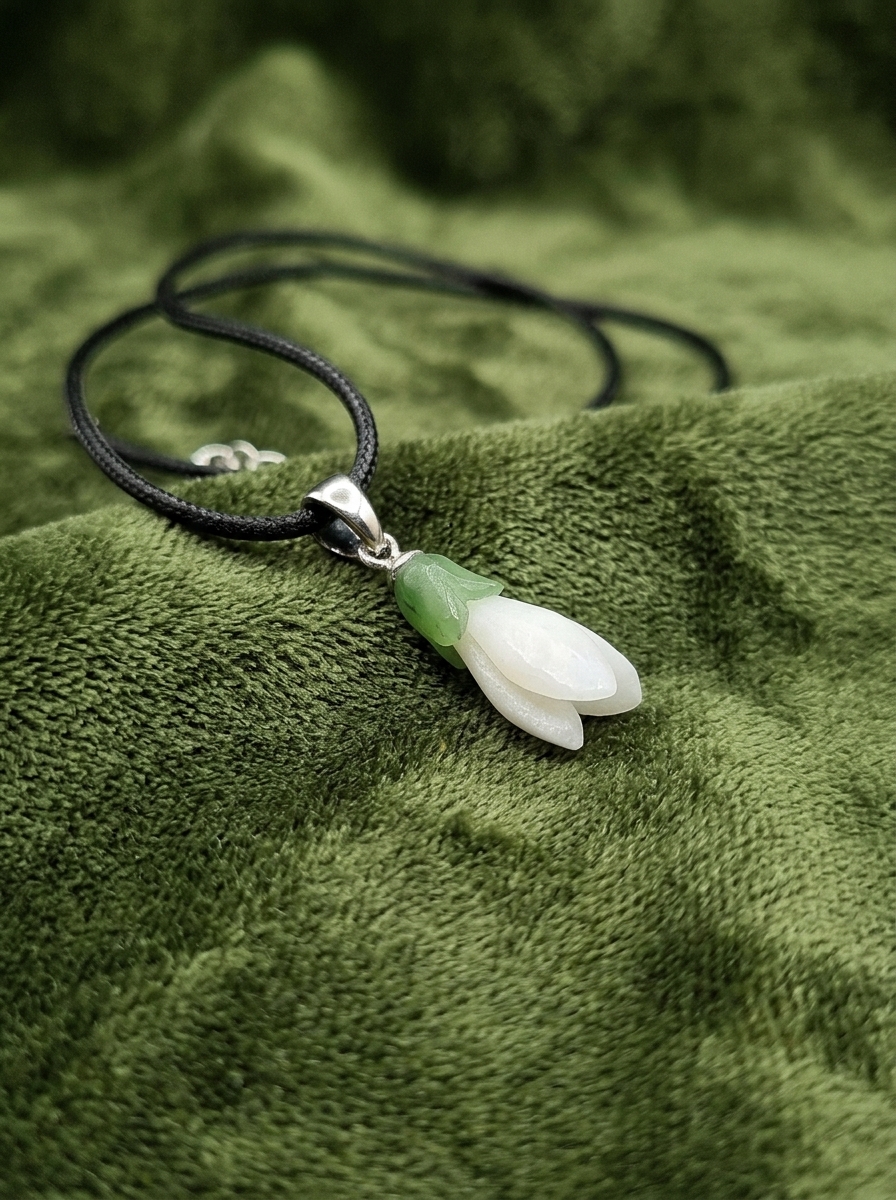
Explore a related in-stock jade piece from Stone-Flower:
Apply one drop of cold 5–10% HCl
Immediate, vigorous bubbling (CO₂) confirms calcite
No bubbles means it’s not calcite
Test #3 – Polarized light confirmation:
Place the crystal over a single line
Look through a polarizing filter (e.g., polarized sunglass lens)
Rotate the filter 90 degrees
One of the two images should disappear completely when the filter aligns with that ray’s polarization plane
What to avoid:
Optical-grade quartz – hardness 7, no acid reaction, birefringence too weak for naked-eye doubling
Synthetic calcite – optically identical but lacks natural fluid inclusions; still genuine calcite but less valuable to collectors
Selenite (gypsum) – hardness 2, scratches with fingernail, birefringent but rarely transparent enough
Glass replicas – no cleavage, no double refraction, hardness 5.5
Optical-Grade Requirements for Iceland Spar
Not every clear calcite specimen qualifies as Iceland spar. True optical-grade material requires:
Internal transparency: No visible fractures, veils, or fluid inclusions when backlit
Perfect cleavage rhombs: Natural fracture surfaces along cleavage planes, not saw-cut
Colorlessness: Any yellow, brown, or gray tint indicates iron or manganese impurities
Minimum size: 10×10×10 mm for practical double refraction demonstration
The classical source is Helgustadir mine in eastern Iceland (now protected—no commercial mining). Modern sources include Mexico (Chihuahua), Brazil, and China. Mexican material dominates the market but often contains microscopic fluid inclusions that slightly reduce transparency.
Practical Applications Beyond Viking Lore
Iceland spar isn’t just a geological curiosity. Before synthetic polarizers, calcite prisms (Glan–Thompson, Nicol prisms, Wollaston prisms) were standard laboratory components for producing and analyzing polarized light. Even today:
Petrographic microscopes use calcite for conoscopic observation of uniaxial minerals
Retardation plates exploit calcite’s predictable birefringence for thin-section analysis
UV-IR optics benefit from calcite’s transparency from 180 nm to 3500 nm—wider than most synthetics
The crystal’s high birefringence means even thin plates (0.2–0.5 mm) produce measurable optical path differences, making Iceland spar ideal for waveplates and beam displacers.
Care and Storage for Calcite Specimens
Calcite’s softness (hardness 3) and perfect cleavage make it fragile. Follow these protocols:
Do not:
Use ultrasonic cleaners – vibrations propagate along cleavage planes
Expose to any acid – even weak acetic acid (vinegar) dissolves calcite over time
Store with harder minerals – quartz, corundum, or steel will scratch surfaces
Subject to thermal shock – sudden temperature changes cause cleavage separation
Do:
Clean with distilled water, soft brush, and neutral pH soap only
Dry immediately with soft lint-free cloth (water spots etch calcite)
Store in padded boxes individually wrapped in acid-free tissue
FAQ: Common Reader Questions
Q1: Can any calcite show double refraction, or only Iceland spar?
Every single calcite crystal shows double refraction because the trigonal crystal structure is intrinsically anisotropic. However, most calcite is too cloudy, fractured, or fine-grained to see the effect without magnification. Iceland spar is the rare transparent, large-crystal variety that makes double refraction visible to the naked eye.
Q2: How do I tell genuine Iceland spar from synthetic calcite or glass?
Three quick tests: (1) Acid test – genuine calcite fizzes in cold HCl, glass does nothing. (2) Hardness – calcite scratches with a copper coin (hardness 3); glass (hardness 5.5) does not scratch. (3) Double refraction – calcite shows two sharp lines; glass shows one blurry line. Synthetic calcite is chemically identical to natural material but lacks natural fluid inclusions visible under 10x magnification.
Q3: Is calcite related to jade? Can I buy jade pendants on your website?
No relationship. Calcite is a soft carbonate mineral (hardness 3) with perfect cleavage – unsuitable for daily-wear jewelry. Jade (nephrite or jadeite) is a tough silicate (hardness 6–7) ideal for pendants and carvings. Что кулоны из нефрита можно купить на нашем сайте – yes, we offer certified nephrite jade pendants. But Iceland spar is a display specimen and optical tool, not a gemstone for wearing.
Final Expert Note
Iceland spar transforms a common carbonate into a physics demonstration you can hold in your hand. The double refraction isn’t subtle or academic—it’s immediate, visual, and repeatable. When you rotate a clear calcite rhomb and watch one printed line become two, you’re observing the direct consequence of trigonal symmetry and light’s interaction with an anisotropic atomic lattice.
For collectors, prioritize optical clarity over size. A 20×20×20 mm cleavage rhomb with perfect internal transparency and sharp double refraction is more scientifically valuable than a 100 mm block full of fractures. Always perform the acid test on an inconspicuous corner to confirm identity. And remember: if a seller claims “double refraction” but you see only blur, walk away. Real Iceland spar never