The Pink Legacy: Deciphering the Pinnacle of Pink Diamond Rarity
The geological narratives etched within precious stones are often profound, but few tell a tale as captivating and technically significant as The Pink Legacy. An astonishing 18.96-carat Fancy Vivid Pink diamond, this gem transcends mere beauty to become a cornerstone in the study of natural diamond coloration and rarity. Its journey from Earth’s mantle to the auction block at Christie’s in Geneva, where it fetched a staggering $50 million, underscores its unparalleled gemological importance and market dominance. This isn’t just a diamond; it’s a testament to the Earth’s intricate processes and a benchmark for extraordinary natural phenomena.The Unparalleled Hue: Understanding “Fancy Vivid Pink”
The most striking attribute of The Pink Legacy is its color: “Fancy Vivid Pink.” To a gemologist, this designation from the Gemological Institute of America (GIA) is not merely descriptive; it’s a profound statement of rarity and perfection. The GIA’s color grading scale for fancy-colored diamonds is a meticulously calibrated spectrum, assessing three primary components: hue (the dominant color), tone (lightness or darkness), and saturation (intensity of color). The scale progresses from Faint, Very Light, Light, Fancy Light, Fancy, Fancy Intense, Fancy Vivid, to Fancy Deep/Dark. “Fancy Vivid” represents the absolute zenith of color saturation for a given hue, exhibiting an intense, pure, and vibrant color without any distracting modifiers. For pink diamonds, achieving a “Vivid” grade is exceptionally rare. Most natural pink diamonds exhibit a weaker saturation, often appearing as Fancy Light or Fancy Pink. The sheer depth and uniform distribution of pink throughout The Pink Legacy’s 18.96-carat mass, without secondary color modifiers, elevates it to an elite echelon where very few diamonds reside. This pure, unadulterated pink is a visual marvel, reflecting an ideal convergence of geological conditions.The Enigma of Pink: A Deep Dive into Color Origin
Unlike yellow or blue diamonds, whose colors are typically attributed to trace elements like nitrogen or boron respectively, the origin of pink in natural diamonds is far more complex and still a subject of ongoing scientific inquiry. The prevailing theory, supported by extensive spectroscopic analysis, points to **plastic deformation** within the diamond’s crystal lattice structure. During the diamond’s formation deep within the Earth’s mantle, or subsequent ascent, immense pressure and temperature can cause structural distortions, creating glide planes or lamellae where the carbon atoms are shifted from their ideal positions. These localized areas of strain selectively absorb specific wavelengths of light, primarily in the green portion of the visible spectrum, allowing red and pink light to be transmitted, thus imparting the characteristic pink hue. Crucially, **the absence or extremely low concentration of nitrogen** is a prerequisite for these structural defects to produce a pure pink color. If significant nitrogen impurities were present, they would tend to absorb other light wavelengths, potentially masking or altering the pink coloration. This interplay of structural defects and compositional purity makes natural pink diamonds particularly rare and scientifically intriguing.The Significance of Type IIa Classification
Further enhancing The Pink Legacy’s distinction is its classification as a **Type IIa diamond**. This designation is of paramount importance in advanced gemology. Type IIa diamonds are exceptionally rare, constituting less than 2% of all natural diamonds. Their defining characteristic is an almost complete absence of nitrogen impurities in their crystal structure. This lack of nitrogen translates into several critical attributes:- Exceptional Purity: Type IIa diamonds are essentially pure carbon, allowing for superior transparency and brilliance.
- Superior Color Potential: For fancy-colored diamonds, the absence of nitrogen means there are no chromophores (color-causing impurities) that might interfere with or compete against the color-causing structural defects. This allows the inherent pink coloration, derived from plastic deformation, to manifest with maximum purity and intensity, contributing directly to the “Fancy Vivid” grade.
- Historical Context: Many of the world’s most famous and historically significant diamonds, including the Cullinan and Koh-i-Noor, are Type IIa, underscoring their exceptional quality.
Weighing Rarity: 18.96 Carats of Pink Perfection
Explore a related in-stock jade piece from Stone-Flower:
Snowdrop Jade Pendant — White & Green Siberian Nephrite, Hand-Carved, 2.5 cm to Pinterest (opens in a new window)

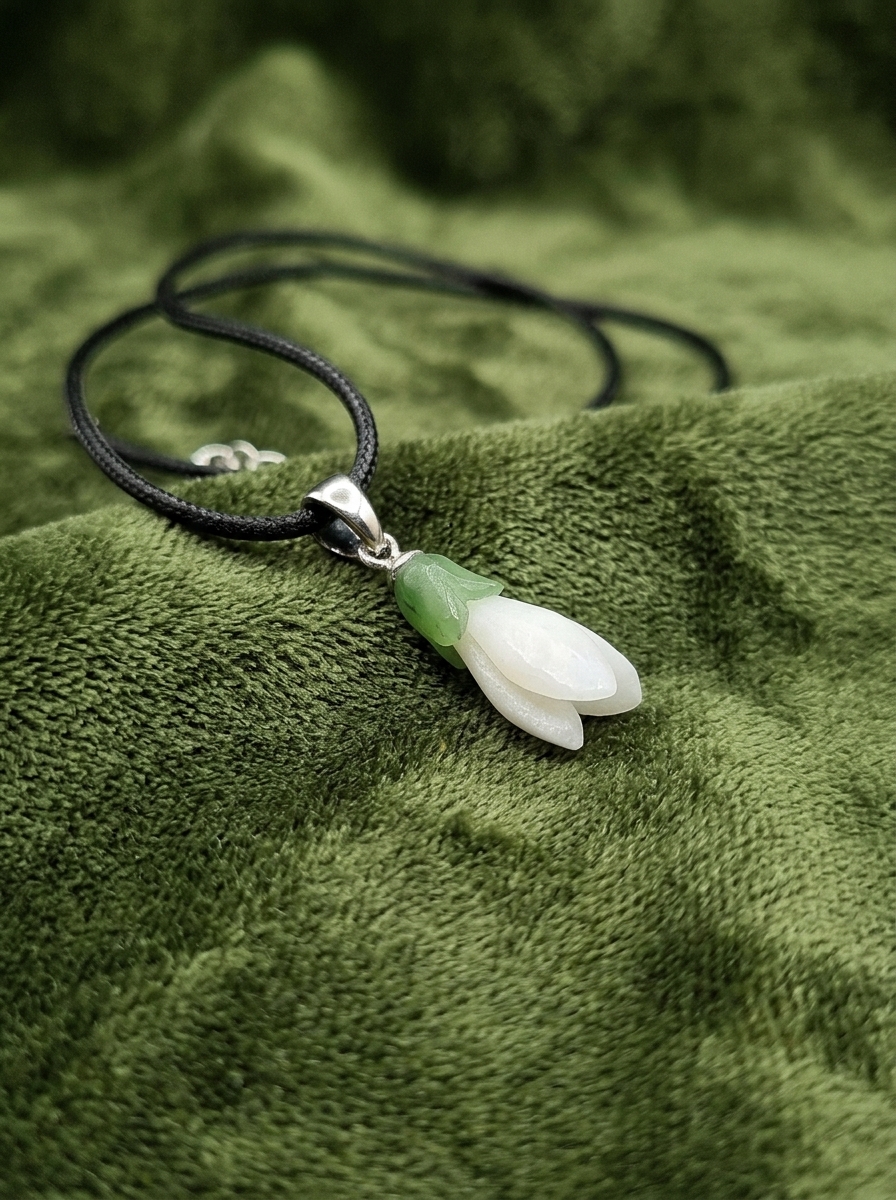
Snowdrop Jade Pendant — White & Green Siberian Nephrite, Hand-Carved, 2.5 cm
Hand-Carved Siberian Jade "Snowdrop" Pendant (2.5 cm)
A delicate botanical flower pendant measuring 2.5 cm in length, hand-carved from genuine Siberian jade. Features three sculpted petals of translucent white jade beneath a rich green jade sepal. Finished with meticulous hand polishing without waxes, varnishes, or chemical sealants, highlighting the pure natural luster of the stone. Fitted with a hypoallergenic medical-grade metal bail on a cord.