The Blue Empress: A Peerless 14-Carat Pear-Shaped Blue Diamond
The unveiling of “The Blue Empress” sends ripples across the most discerning echelons of the gemological and haute joaillerie worlds. At a staggering 14 carats, this pear-shaped blue diamond is not merely a gemstone; it is a geological marvel, a testament to Earth’s profound mysteries, and an emblem of unparalleled rarity. Set within a meticulously crafted necklace of scintillating white diamonds, The Blue Empress transcends mere adornment, representing the pinnacle of natural beauty married with human artistry. Its appearance commands attention, not just for its breathtaking aesthetic, but for the profound technical nuances that define its existence and value.
The Deep Geologic Secret of Blue Diamonds: Type IIb Boron-Rich Anomalies
Blue diamonds, especially those of significant carat weight like The Blue Empress, are among the Earth’s rarest treasures. Their distinctive azure hue is not attributed to elemental impurities trapped during formation, as is common with other fancy color diamonds. Instead, it is primarily caused by trace amounts of boron atoms substituting for carbon atoms within the diamond’s crystal lattice. This unique atomic configuration classifies them as Type IIb diamonds, a category representing less than 0.1% of all natural diamonds. The presence of boron dictates an extraordinary origin story. Unlike most diamonds that form at depths of 150-200 km, Type IIb blue diamonds are believed to crystallize at extreme depths, often exceeding 660 km within the lower mantle, sometimes even touching the mantle transition zone. Here, boron, which is generally scarce in Earth’s mantle, is thought to be introduced via subducted oceanic crust rich in hydrous minerals and boron-bearing sediments. The immense pressures and temperatures at these depths facilitate the incorporation of boron into the diamond’s structure, leading to its characteristic semiconducting properties and, consequently, its mesmerizing blue color. This deep-earth genesis makes a 14-carat specimen like The Blue Empress an almost unthinkable natural occurrence, having navigated violent volcanic eruptions to reach the surface intact.Unpacking the Rarity: Color, Clarity, and Cut for the Blue Empress
The true essence of The Blue Empress lies in its exceptional color. Gemological Institute of America (GIA) fancy color grading assesses diamonds based on hue, tone, and saturation. A diamond of this caliber would undoubtedly fall into the coveted categories of Fancy Intense Blue, Fancy Vivid Blue, or even Fancy Deep Blue, distinguished by a rich, unadulterated blue saturation with minimal secondary hues (overtones), such as grayish or greenish modifiers. The absence of these overtones significantly amplifies its value and aesthetic appeal. Clarity, while crucial, often takes a secondary role to color in fancy colored diamonds. However, for a stone like The Blue Empress, even minor inclusions can significantly detract from its visual impact and perceived color depth. An expert gemologist would scrutinize its internal landscape for any boron-rich inclusions or other clarity characteristics that could be specific to Type IIb diamonds, ideally seeking a clarity grade of VS2 (Very Small Inclusions 2) or higher to maintain its elite status.The Art of Color Maximization in Cutting
The pear shape of The Blue Empress is not coincidental; it is a deliberate and masterful choice designed to optimize the stone’s rare color. For fancy color diamonds, the cutter’s primary goal is to enhance and maximize the perceived body color, often prioritizing this over traditional brilliance and fire seen in colorless diamonds. The elongated pavilion and specific facet arrangement of a pear shape allow for a greater concentration of light within the stone, intensifying its blue hue. This requires a cutter with an unparalleled understanding of light behavior within colored diamonds, often involving specific pavilion depths and angles that would be considered unconventional for a colorless stone, all to ensure “The Blue Empress” radiates its most profound blue.The Masterful Setting: A Symphony of White Diamonds and Platinum
Explore a related in-stock jade piece from Stone-Flower:
Snowdrop Jade Pendant — White & Green Siberian Nephrite, Hand-Carved, 2.5 cm to Pinterest (opens in a new window)

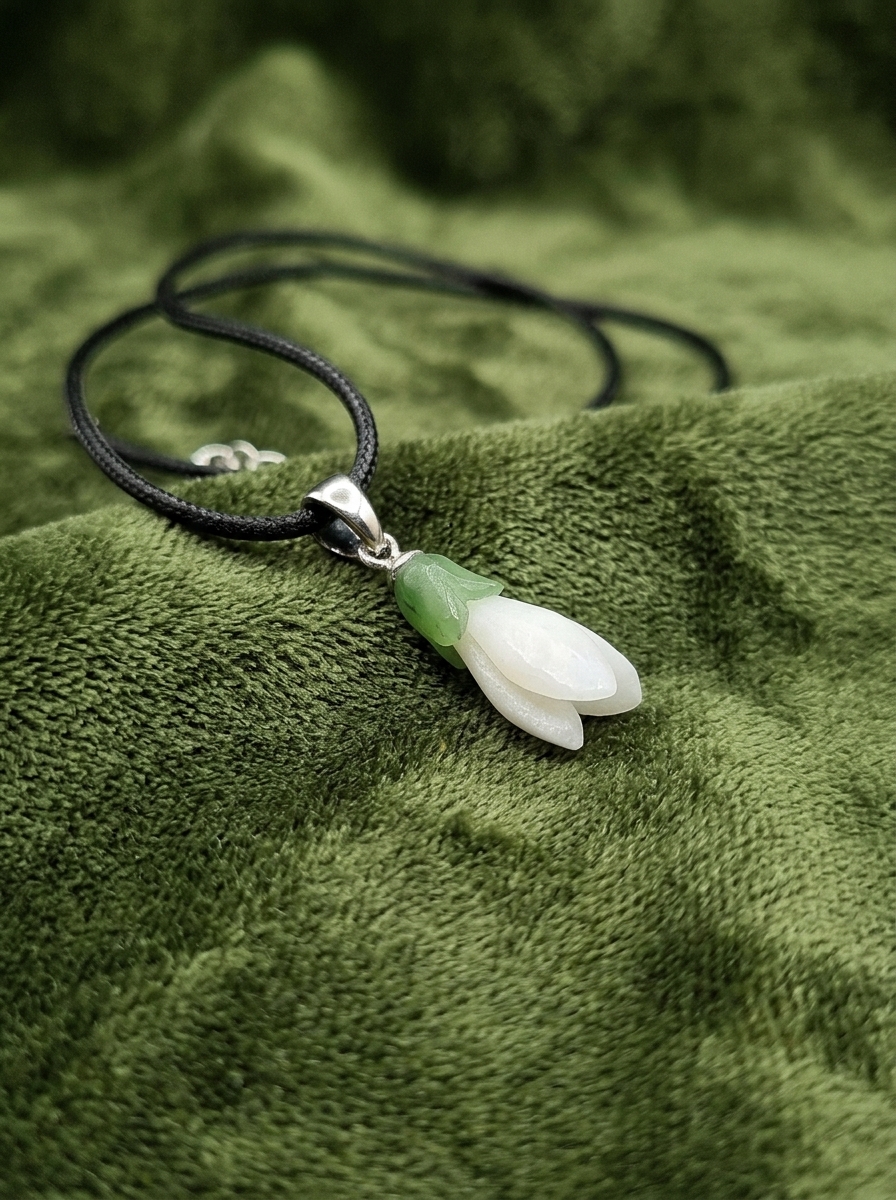
Snowdrop Jade Pendant — White & Green Siberian Nephrite, Hand-Carved, 2.5 cm
Hand-Carved Siberian Jade "Snowdrop" Pendant (2.5 cm)
A delicate botanical flower pendant measuring 2.5 cm in length, hand-carved from genuine Siberian jade. Features three sculpted petals of translucent white jade beneath a rich green jade sepal. Finished with meticulous hand polishing without waxes, varnishes, or chemical sealants, highlighting the pure natural luster of the stone. Fitted with a hypoallergenic medical-grade metal bail on a cord.