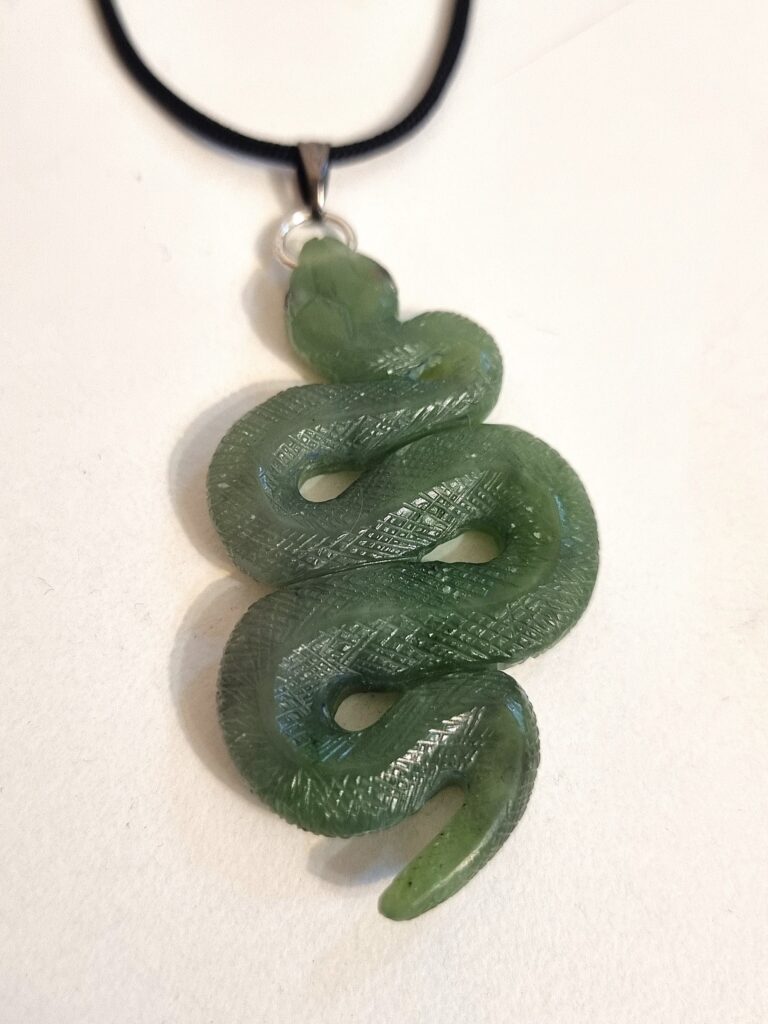
A handmade jade pendant necklace can be a wearable piece of sculpture, but choosing one takes more than matching a shade of green to an outfit. Check what the stone is identified as, how the carving is finished, how the pendant hangs, and whether the cord or chain is actually included. This guide gives you a practical checklist before you buy.
1. Check what “jade” means in the listing
Jade is a broad gemological name that includes nephrite and jadeite; the two are different materials. A listing that says only “jade” does not tell you which one the piece contains. If nephrite is important to you, look for an explicit material statement and ask the seller if it is unclear. Color in a photograph is not a reliable way to identify the material. The Gemological Institute of America’s jade buyer’s guide explains the distinction and the factors buyers may consider.
2. Read the material and treatment disclosures
A useful product description names the stone as specifically as the seller can support and states whether any treatments are known. “Natural,” “untreated,” and “nephrite” are not interchangeable claims, so check the wording rather than assuming one proves another. If a certificate or report is offered, confirm which item it covers and who issued it. For a handmade jade pendant necklace, honest limits are helpful too: a maker may not know the mine or full geological origin of a stone.
3. Look closely at the carving and finish
Inspect the design from the front, side, and back. Notice whether the silhouette is easy to read, the transitions between raised and recessed areas look intentional, and small details appear carefully finished. Hand carving naturally allows small differences between pieces; that variation is part of a one-off object, not proof of quality by itself. Ask for close-ups or a short video in neutral light if the photographs do not show the surface clearly.
4. Compare the size with your everyday jewelry
Use the stated height and width to picture the pendant against a ruler or a piece you already own. Check thickness as well: two pendants with the same height can feel very different when worn. A larger sculptural carving may need a stronger chain or cord and can move more while you walk. Weight is useful if the listing provides it; if it does not, ask before ordering rather than estimating from a close-up photo.
5. Confirm the bail, cord, or chain
The word “necklace” can refer to a complete pendant-and-chain set, while many listings sell the carved pendant alone. Check whether the chain or cord is included, what material it is, and whether the bail opening will fit your own chain. Look at how the pendant is oriented when suspended. A secure fitting should hold the piece in the position intended by the design, without forcing a narrow cord through an unsuitable opening.
6. Choose a design you will actually wear
Think about scale, color, neckline, and how often you plan to wear the piece. A compact carving may work with a simple everyday cord; a longer or more detailed pendant can become the focal point of an outfit. Consider whether you prefer a floral, geometric, or animal motif, and whether the carving’s front and back both matter to you. The best choice is the one whose form and practical details suit your habits, not a universal “perfect” style.
7. Ask how to care for the finished piece
Nephrite and jadeite are notably tough, yet they can still be scratched. GIA recommends gentle cleaning with warm soapy water or a soft cloth for jade jewelry; avoid assuming that aggressive polishing or household chemicals are appropriate, especially where a pendant has metal fittings or accent stones. Store it separately from harder jewelry and remove it before activities where it could take a hard impact. See the GIA jade care and cleaning guide for more detail.
8. Review the exact-item photos and return terms
For a one-of-a-kind handmade jade pendant necklace, verify that the photographs show the actual item for sale, not just a similar example. Ask about natural color variation, shipping, returns, and what is included in the package. Read the seller’s current terms before checkout. A clear answer to these questions is more useful than a broad promise that a piece is “high quality.”
A real example: a 52 mm carved jade snake pendant
Stone Flower’s listing describes a hand-carved Siberian green jade snake pendant measuring 52 mm, with a sculpted S-curve, engraved scales, and 2 mm natural faceted garnet eyes. It specifies a metal jump ring and bail and says the piece is ready for a cord or chain. The listing describes hand polishing and states that the finish has no lacquers, waxes, or chemical treatments. This is a pendant listing, so check the product page for current availability and confirm whether a cord or chain is included before ordering.

Jade Serpent Pendant with Garnet Eyes — Hand-Carved Green Nephrite, 52 mm
Hand-Carved Siberian Green Jade Snake Pendant with Garnet Eyes (52 mm)
A bold, handcrafted snake pendant measuring 52 mm in length, sculpted by hand from a solid piece of natural Siberian green jade. The serpent is captured in an elegant undulating S-curve with finely carved dorsal scales and expressive 2 mm natural faceted red garnet eyes. Fitted with a secure metal jump ring and bail at the mouth, ready for a cord or chain. Finished with fine hand polishing without lacquers, waxes, or chemical treatments, highlighting the stone’s authentic, silky luster.
When comparing a handmade jade pendant necklace with this example, focus on the features that can be checked: the stated stone, measured length, carving details, fittings, and photographs. The product card shows the current listing; price and stock can change, so use the product page for the latest details.
Quick buyer checklist
- Does the listing identify nephrite or jadeite, if that distinction matters to you?
- Are known treatments and unknown details described clearly?
- Do the images show the actual pendant from several angles?
- Are dimensions, thickness, and ideally weight stated?
- Is a chain or cord included, and will the bail fit it?
- Have you checked care, shipping, and return information?
For another buyer-focused overview, read our guide to choosing a hand-carved nephrite jade pendant. Each carving is individual, so compare specific details and ask the seller about anything the listing does not answer.