1. Goshenite Defined: Why “Pure Beryl” Is Technically an Anomaly
From a crystallographic standpoint, pure beryl belongs to the space group P6/mcc with hexagonal symmetry. Its chemical formula appears simple: Be₃Al₂Si₆O₁₈. But in nature, “pure” is a spectrum. True Goshenite contains less than 0.01% transition metal ions (Cr, V, Fe, Mn). This absence of d-electron transitions means zero light absorption in the visible range (390–700 nm) – hence water-clear transparency. Professional secret #1: Most “colorless” beryl still contains alkali metals (Li⁺, Na⁺, Cs⁺) in structural channels parallel to the c-axis. These do not cause color but affect refractive index. Pure Goshenite exhibits nω = 1.566–1.572 and nε = 1.560–1.566 – slightly lower than emerald due to fewer channel impurities. Use a refractometer with a sodium light source (589 nm) to distinguish true Goshenite from pale beryl variants. In contrast, emerald owes its green to ~0.15–0.60 wt% Cr₂O₃ or V₂O₃. That same chromium introduces strain birefringence and three-phase inclusions (solid, liquid, gas) – the classic “jardin” that devalues emeralds. Pure beryl lacks these entirely, offering clarity that only top-tier aquamarine can approach.2. The Trace Element Alchemy: From Goshenite to Emerald, Aquamarine, and Morganite
Understanding pure beryl means decoding how impurity substitution creates an entire gemstone family. Here is the chemical transformation:- Emerald (green): Cr³⁺ or V³⁺ substitutes for Al³⁺ in octahedral sites. The absorption bands at 425 nm (violet) and 600 nm (red) produce green. Too much Cr causes concentration quenching – dark, nearly black stones.
- Aquamarine (blue): Fe²⁺ at Al sites. Heat treatment at 400–450°C oxidizes Fe²⁺ → Fe³⁺, shifting color from greenish-blue to pure blue. Pure beryl would never react to heat without iron.
- Morganite (pink): Mn²⁺ plus natural gamma irradiation. Some morganite began as Goshenite, later exposed to manganese-rich hydrothermal fluids.
- Heliodor (yellow): Fe³⁺ or color centers from natural irradiation of Fe²⁺-bearing beryl.
Explore a related in-stock jade piece from Stone-Flower:
Snowdrop Jade Pendant — White & Green Siberian Nephrite, Hand-Carved, 2.5 cm to Pinterest (opens in a new window)

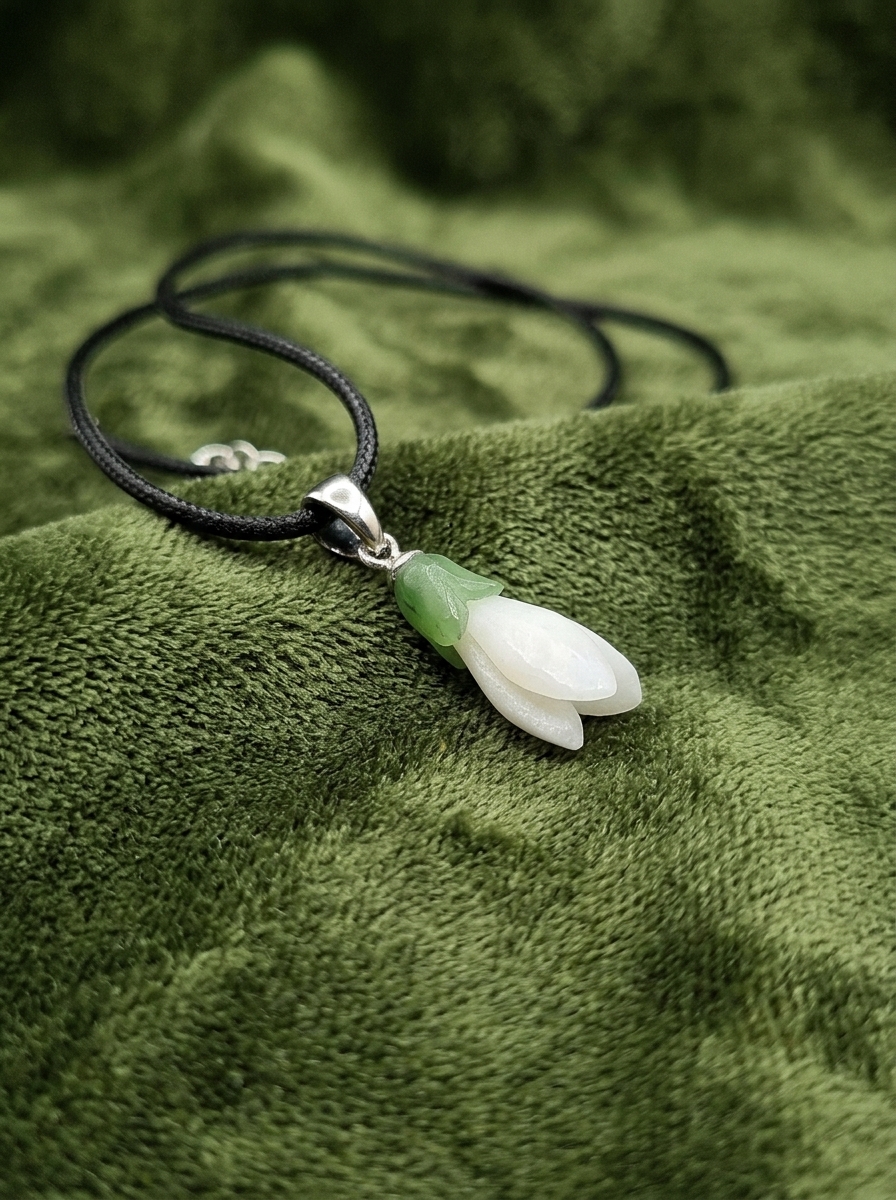
Snowdrop Jade Pendant — White & Green Siberian Nephrite, Hand-Carved, 2.5 cm
Hand-Carved Siberian Jade "Snowdrop" Pendant (2.5 cm)
A delicate botanical flower pendant measuring 2.5 cm in length, hand-carved from genuine Siberian jade. Features three sculpted petals of translucent white jade beneath a rich green jade sepal. Finished with meticulous hand polishing without waxes, varnishes, or chemical sealants, highlighting the pure natural luster of the stone. Fitted with a hypoallergenic medical-grade metal bail on a cord.
3. Why Collectors Hunt Goshenite: Rarity, Optical Physics, and the Hidden Market
While commercial buyers fight over heated aquamarine, facet-grade Goshenite over 10 carats is genuinely rare. Why? Because beryl crystals almost always incorporate impurities during pegmatitic growth. Pure beryl forms only in Li-Cs-depleted environments – typically in alpine-type fissures or specific granitic pegmatites with extremely clean fluid compositions. Top sources include:- Paprok, Afghanistan – crystals up to 30 cm, often with dihexagonal dipyramids.
- Erongo Mountains, Namibia – water-clear, etched crystals prized for mineralogical studies.
- Golconda region, Brazil – small but flawless facet rough.