Vintage vs. Antique vs. Estate Jewelry: The Expert Guide
You’ve found a stunning piece of jewelry in a velvet-lined box at a local boutique or passed down through generations. It’s old, it’s beautiful, but what exactly is it? In the world of high-end horology and fine jewelry, terms like “vintage,” “antique,” and “estate” are frequently used interchangeably by casual sellers, but for the discerning collector or investor, the distinctions are critical. Mislabeling a piece isn’t just a semantic error—it’s a valuation mistake that can cost thousands of dollars. Understanding these definitions is the first step in building a meaningful collection or making an informed purchase. Let’s dive into the technical nuances that separate a 1920s Art Deco masterpiece from a 1980s retro find.What Defines Antique Jewelry?
In the strictest sense, the term “antique” is defined by age. According to United States Customs and most international trade bodies, an item must be at least 100 years old to be classified as an antique. When evaluating antique jewelry, experts look for specific manufacturing markers that pre-date mass production. Before the mid-20th century, jewelry was largely handcrafted, meaning you will often find unique tool marks and slightly asymmetrical settings. Key eras for antique jewelry include:- Georgian (1714–1837): Known for being incredibly rare, often featuring “closed-back” settings where the gemstone is backed by foil to enhance brilliance under candlelight.
- Victorian (1837–1901): Divided into the Romantic, Grand, and Aesthetic periods, featuring motifs like snakes, mourning jewelry, and the rise of 15k gold.
- Edwardian (1901–1915): Notable for the introduction of platinum, allowing for delicate, lace-like “filigree” work that was impossible with softer gold.
Technical Tip: Identifying Antique Diamonds
One of the easiest ways to verify an antique status is the cut of the stone. If you see an Old European Cut or an Old Mine Cut, characterized by a small table, a high crown, and a large culet (the flat facet at the bottom of the stone), you are likely looking at a piece from the 19th or early 20th century. Modern “Round Brilliant” cuts were not standardized until the 1919 Tolkowsky model.Decoding Vintage Jewelry
If a piece is not 100 years old but is at least 20 to 30 years old, it falls into the vintage category. “Vintage” implies that the piece represents a specific era or “vantage” point in design history. Currently, jewelry from the 1920s (which is transitioning into antique status) through the early 1990s is considered vintage. Vintage jewelry is often categorized by its design movement:- Art Deco (1920s–1930s): Characterized by geometric shapes, bold colors (emeralds, sapphires), and the heavy use of white gold and platinum.
- Retro (1940s): Largely influenced by WWII, these pieces use “Rose Gold” and “Yellow Gold” because platinum was reserved for military use. Designs are oversized and “Hollywood Glamour” inspired.
- Mid-Century (1950s): A shift toward more feminine, whimsical designs featuring textures like “brushed gold” or “woven wire.”
What is Estate Jewelry?
Explore a related in-stock jade piece from Stone-Flower:
Snowdrop Jade Pendant — White & Green Siberian Nephrite, Hand-Carved, 2.5 cm to Pinterest (opens in a new window)

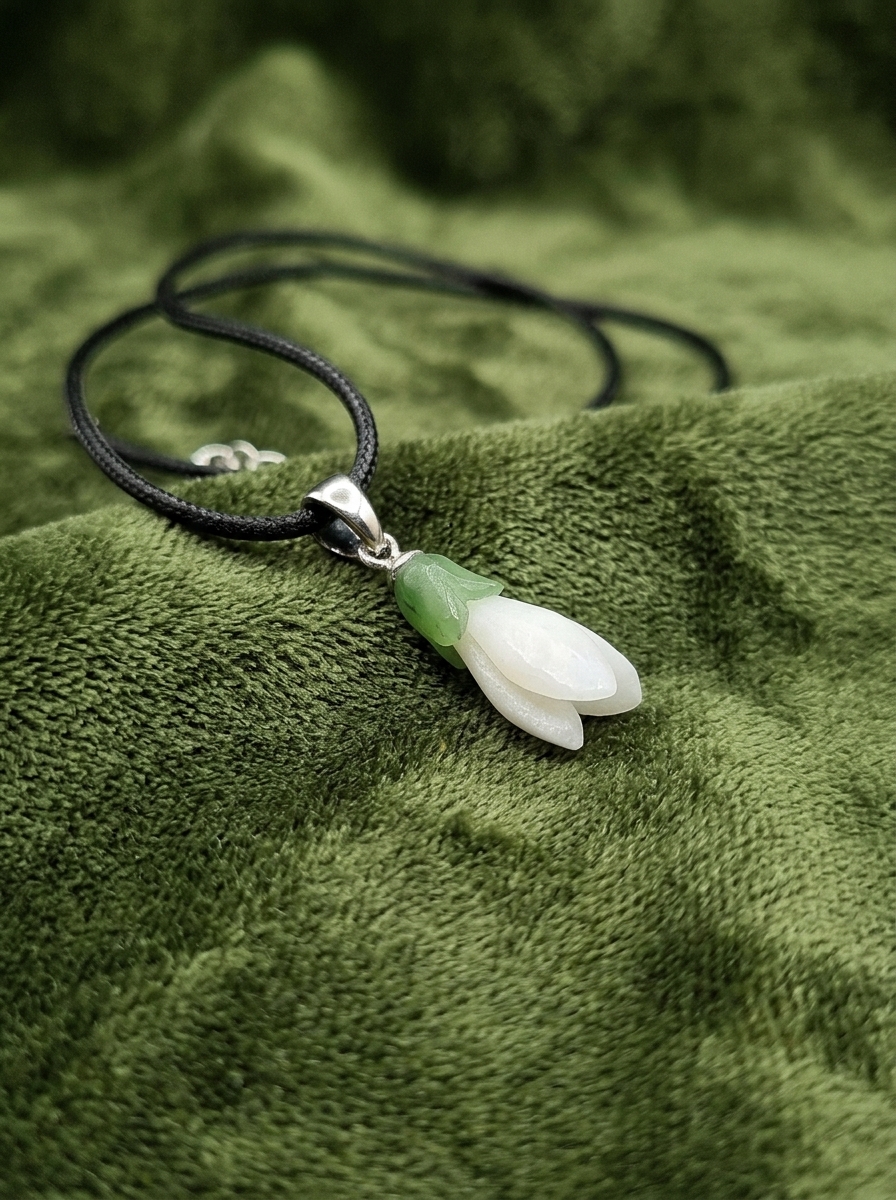
Snowdrop Jade Pendant — White & Green Siberian Nephrite, Hand-Carved, 2.5 cm
Hand-Carved Siberian Jade "Snowdrop" Pendant (2.5 cm)
A delicate botanical flower pendant measuring 2.5 cm in length, hand-carved from genuine Siberian jade. Features three sculpted petals of translucent white jade beneath a rich green jade sepal. Finished with meticulous hand polishing without waxes, varnishes, or chemical sealants, highlighting the pure natural luster of the stone. Fitted with a hypoallergenic medical-grade metal bail on a cord.