Behold the Moussaieff Red: Rarest Diamond, Unveiling its Secrets
In the pantheon of Earth’s most exquisite treasures, one gem stands alone, shrouded in a crimson mystique that defies common understanding: the Moussaieff Red. A 5.11-carat Fancy Red diamond, it is not merely rare; it is a geological anomaly, a testament to the planet’s profound and often violent artistry. This isn’t just a story about a precious stone; it’s an exploration into the almost mythical science that creates a color so elusive, so saturated, that it redefines scarcity in the gemological world.The Phenomenon of Red Diamonds: A Deep Dive into Color Origin
Unlike most other fancy colored diamonds, whose hues derive from trace elemental impurities—such as nitrogen for yellow diamonds or boron for blue diamonds—the vivid red in a diamond like the Moussaieff Red originates from a far more intricate and less common process. This isn’t about doping; it’s about structural distortion. Scientists and gemologists largely agree that the red color arises from what is known as plastic deformation within the diamond’s crystal lattice. Deep within the Earth’s mantle, under immense pressure and high temperatures, the diamond crystal experiences structural defects and slippages along its atomic planes. These internal stresses and strains, particularly along {111} slip planes, cause irregularities in the electron structure, leading to selective light absorption in the blue-green portion of the visible spectrum. What remains, reflected back to our eyes, is the spectacular, saturated red. Critically, these conditions must occur without subsequent recrystallization that would repair the lattice, preserving the deformation-induced color.Geological Genesis: A Rarity Beyond Rarity
For a diamond to form with such pronounced plastic deformation, without also accumulating sufficient nitrogen to create a yellow hue (most natural diamonds are Type Ia, rich in nitrogen), or without undergoing extensive graphitization due to excessive heat, is a profoundly rare event. The conditions necessary are a confluence of factors:- Extreme Pressure: Far beyond the typical formation depths, fostering significant lattice deformation.
- Specific Temperature Regimes: High enough to facilitate plastic flow but not so high as to cause graphitization or recrystallization.
- Lack of Impurities: Predominantly Type IIa diamonds, meaning they contain virtually no nitrogen, allowing the structural deformation to be the sole chromophore.
- Rapid Ascent: A swift journey to the Earth’s surface via kimberlite or lamproite pipes, preventing the annealing of the crystal lattice that would otherwise erase the color-causing defects.
The Moussaieff Red: A Masterpiece of Scarcity
Discovered in the Abaetezinho River in Brazil in the 1990s by a farmer, the rough diamond weighed 13.90 carats. Initially known as the “Red Shield,” its journey from rough stone to polished masterpiece was one of meticulous craftsmanship and calculated risk. The rough was acquired by the prominent diamantaire William Goldberg, who oversaw its transformation into a brilliant-cut, triangular modified brilliant shield cut. This particular cut was chosen to maximize the face-up color saturation, a critical consideration for any fancy colored diamond, especially one of this magnitude. After its initial cutting, the diamond was sold to Moussaieff Jewelers, a renowned London-based firm, giving it its current name. Weighing 5.11 carats and possessing an Internal Flawless (IF) clarity grade, the Moussaieff Red is the largest known Fancy Red diamond in the world. Its estimated value exceeds $20 million, though as a privately held jewel, its true market worth is subject to the exclusive world of ultra-high-net-worth collectors.Unraveling the ‘Fancy Red’ Grading
The Gemological Institute of America (GIA) is the global authority for diamond grading, and its system for fancy colors is exceptionally nuanced. For red diamonds, the categories are particularly stringent. Unlike yellow or blue diamonds that have several saturation levels (e.g., Fancy Light, Fancy Intense, Fancy Vivid), there is no “light red” or “dark red.” A diamond must display sufficient saturation to be classified as “Fancy Red” directly. The GIA’s master color graders evaluate fancy colors by assessing three components: hue, tone, and saturation. For red diamonds, the purity of the red hue is paramount. Even a slight hint of purple or orange will result in a modifier, such as “Fancy Purplish-Red” or “Fancy Orangy-Red.” What makes the Moussaieff Red so extraordinary is its pure “Fancy Red” designation, without any secondary hues, a classification bestowed only upon a handful of diamonds in existence. This designation confirms the unparalleled intensity and singular hue derived solely from its unique lattice deformation. Gemologists use advanced spectrophotometric analysis to objectively quantify these color parameters, though the final grade often rests on the experienced eye of a master grader.Market Dynamics and Value: A Gemological Anomaly
Explore a related in-stock jade piece from Stone-Flower:
Snowdrop Jade Pendant — White & Green Siberian Nephrite, Hand-Carved, 2.5 cm to Pinterest (opens in a new window)

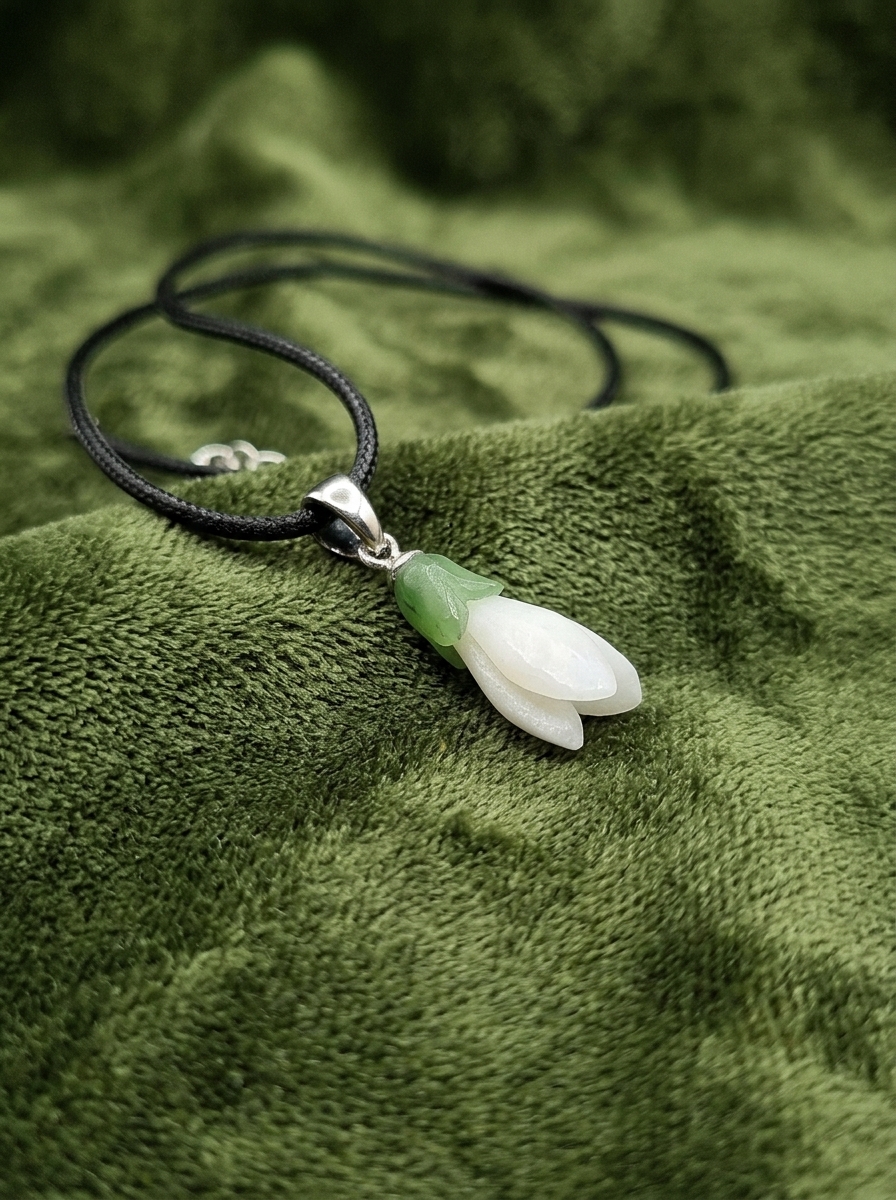
Snowdrop Jade Pendant — White & Green Siberian Nephrite, Hand-Carved, 2.5 cm
Hand-Carved Siberian Jade "Snowdrop" Pendant (2.5 cm)
A delicate botanical flower pendant measuring 2.5 cm in length, hand-carved from genuine Siberian jade. Features three sculpted petals of translucent white jade beneath a rich green jade sepal. Finished with meticulous hand polishing without waxes, varnishes, or chemical sealants, highlighting the pure natural luster of the stone. Fitted with a hypoallergenic medical-grade metal bail on a cord.
The Expertise Behind Rarity: Why Specialists Matter
Authenticating and valuing a diamond of this caliber requires unparalleled expertise. Specialized gemological laboratories employ advanced techniques like Fourier-transform infrared (FTIR) spectroscopy and UV-Vis spectroscopy to confirm natural color origin, rule out treatments (e.g., HPHT, irradiation), and precisely characterize the diamond’s type and internal structure. The meticulous evaluation by GIA ensures the integrity of the diamond’s grade and, consequently, its market value. For those seeking to understand or acquire rare and unique gemstones, partnering with seasoned gemologists is paramount. Experts possessing deep knowledge of geological origins, cutting nuances, and market dynamics can provide invaluable guidance. Organizations such as stone-flower.com are dedicated to sourcing and understanding exceptional natural stones, offering specialized insights into the intricacies of rare gems and their provenance.